
Amethyst:
Properties & Uses
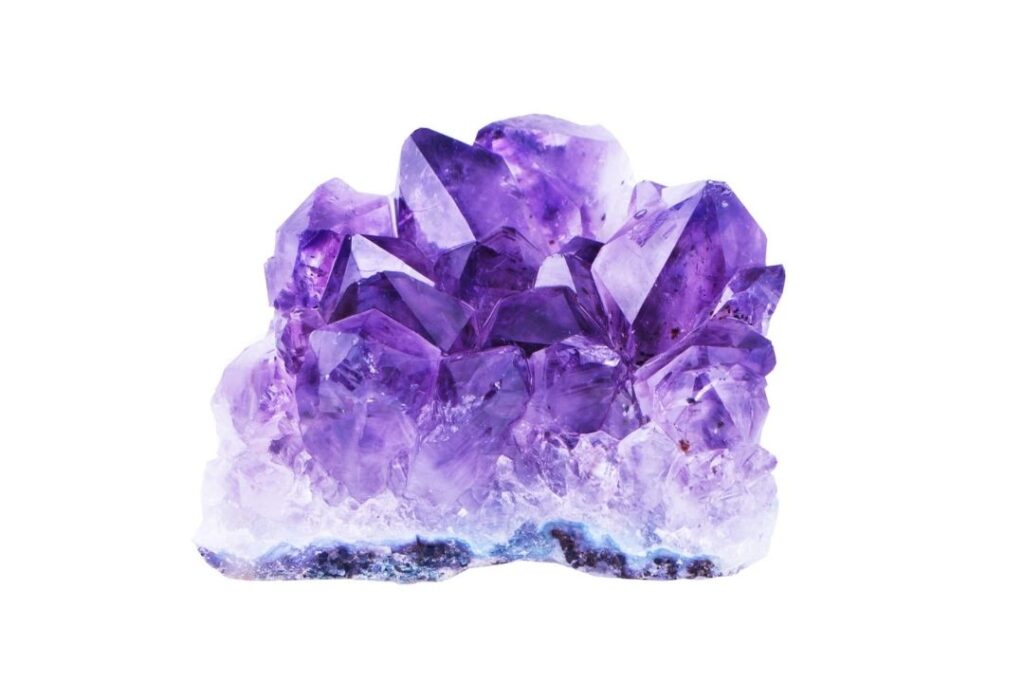
Amethyst occupies a special place among all natural stones, thanks to its beauty and spiritual virtues. With its violet hues ranging from light to deep, it is one of the most sought-after stones in lithotherapy. Associated with serenity, calm and inner equilibrium, it is equally suited to those seeking emotional well-being and those wishing to deepen their meditation practice. In this article, discover the origins of amethyst, its recognized benefits in lithotherapy and its many everyday uses.
Origin and characteristics of Amethyst
Amethyst is a variety of violet quartz, prized since Antiquity for its color and symbolism.
Historically, amethyst has been used since antiquity, notably in ancient Egypt, where it was already being cut into beads, amulets and seals as early as the Middle Kingdom. The Egyptians associated this stone with protective and symbolic functions, and it featured in funerary objects as well as prestigious finery, attesting to its cultural and aesthetic value (Andrews, 1994). Its name is derived from the ancient Greek amethystos, meaning “not drunk”: the Greeks and Romans associated amethyst with temperance and self-control, believing it to protect against excess, particularly drunkenness. It was used in jewelry as well as in goblets and decorative objects for banquets (Ball, 2001). In the Middle Ages, amethyst acquired a strong symbolic value in Europe: it was frequently incorporated into religious objects and ecclesiastical ornaments, where it embodied wisdom, moral clarity and inner balance. This historical continuity explains why amethyst continues to be associated, in contemporary approaches, with symbolic uses linked to calm and introspection, without these interpretations being based on proven physical or medical properties.
Its name comes from the ancient Greek amethystos, meaning “not drunk”, in reference to an ancient belief that this stone protected against excess and promoted clarity of mind (Ball, 2001). Used in jewelry and ritual objects alike, amethyst played an important role in Greek, Roman and medieval cultures.
Mineralogically, amethyst is composed of silicon dioxide (SiO₂). Its violet hue results from the presence of traces of iron in the quartz crystal structure, combined with natural exposure to terrestrial radiation during its geological formation (Klein & Dutrow, 2007). The intensity of the hue can vary from light lilac to deep violet, depending on formation conditions and provenance. The main deposits today are in Brazil, Uruguay, Madagascar and Zambia.
Properties of Amethyst
Warning
Lithotherapy is a non-scientific energy practice. The properties of the stones described in this article are based on tradition and popular belief. They are no substitute for medical treatment. For all health problems, please consult a doctor.
1. Mental and emotional
Soothing stone, ideal for relieving stress and anxiety
Promotes restful sleep and reduces nightmares
Encourages clear thinking and decision-making
2. On a spiritual level
Strengthens spiritual connection and meditation
Helps develop intuition and inner wisdom
Protects against negative energies and addictions
3. On a physical level
Supports hormonal balance
Soothes nervous tension
Helps improve sleep quality
How do I use Amethyst in my daily life?
1. In jewelry
Worn as a bracelet or pendant, Amethyst radiates soothing energy throughout the day.
2. At home
Placing an Amethyst stone in a bedroom promotes relaxation and peaceful sleep. In a living room, it purifies the atmosphere and creates a harmonious ambience.
3. In meditation
Holding a rolled stone or amethyst crystal in the hand helps to calm the mind and deepen meditative practice.
Amethyst purification and recharging
Like all stones, amethyst needs to be purified regularly to retain its energy. It can be cleansed with clear water, fumigation or a Tibetan bowl. To recharge, use moonlight, which is gentler than sunlight, or place it on a quartz geode.
Conclusion
Amethyst is an essential stone in lithotherapy: soothing, protective and spiritual, it accompanies both daily well-being and personal growth. By wearing it as jewelry, placing it in your living spaces or using it for meditation, you’ll benefit from its many virtues.
Bibliography
Klein, C., & Dutrow, B. (2007). Manual of mineral science (23rd ed.). John Wiley & Sons.
Did you like this article?
See also: